Solo Exhibition “tree of life” at Yutaka Kikutake Gallery Roppongi
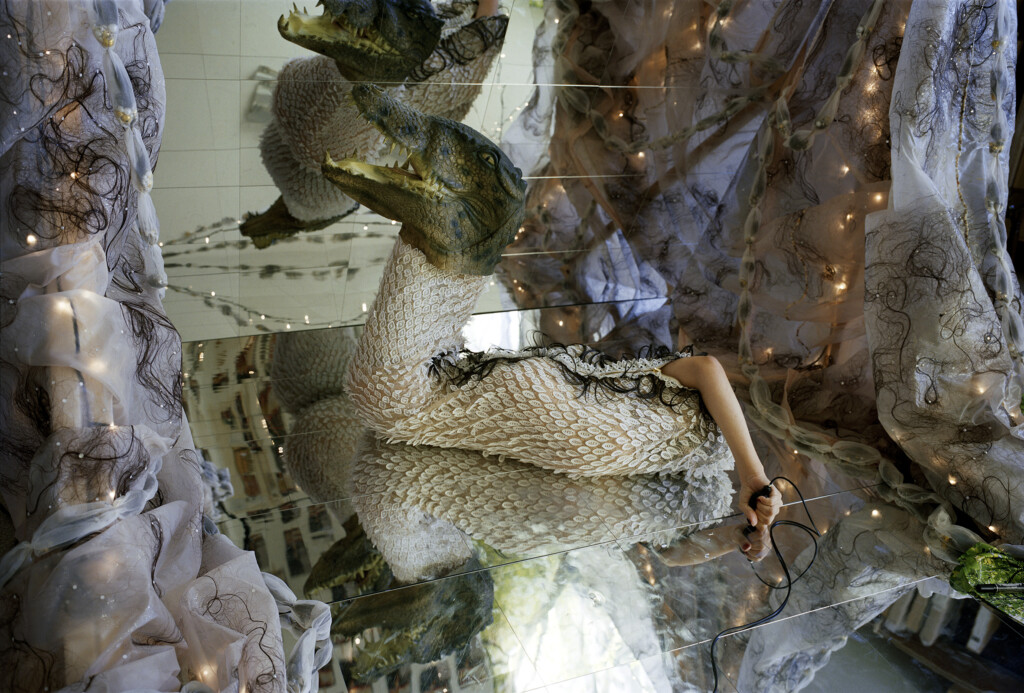
tree of life #04, 2025
Commissioned by the V&A Parasol Foundation Women in Photography project with support from the Parasol Foundation Trust.
Mari Katayama
tree of life
March 19 (Thu) – May 16 (Sat), 2026
12:00 – 19:00 Closed on Sun, Mon and National Holidays
Yutaka Kikutake Gallery Roppongi
https://www.yutakakikutakegallery.com/exhibitions/tree-of-life/
Piramide building. 2F, 6-6-9 Roppongi, Minato-ku, Tokyo,
106-0032, Japan
With her own physicality and its relationship to the wider world as her central motif, Mari Katayama (b.1987 in Saitama Prefecture, raised in Gunma Prefecture; currently lives and works in Gunma Prefecture) produces an eclectic oeuvre that encompasses a wide range of fields from intricately crafted handsewn objects to photographic works, video, and art projects. Katayama’s work is autobiographical yet evokes universal empathy, questioning how the “roles” and “frameworks” society imposes upon individuals shape the boundaries between self and other, as well as what constitutes “correctness.” In 2025, Katayama produced commissioned works for the Victoria and Albert Museum in the UK (supported by the V&A Parasol Foundation Women in Photography project). This exhibition, which marks the opening of Yutaka Kikutake Gallery’s new Roppongi space, will be the first opportunity to present the artist’s latest body of work in Japan, including the “tree of life” series newly acquired by the V&A.
“tree of life” is a series of ten photographic works in which Katayama herself appears as the subject within a mirrored space constructed by her in her own studio. Surrounded by handsewn objects, her outline reflected in the mirrored surface appears strikingly ambiguous, making it unclear whether it is a mirror image or a real image. Sky and earth, reality and illusion, inside and outside, self and other—the reflections produced by the mirrors blur all contours, as if the generation of proliferating images is repeated infinitely. This work deeply reflects Katayama’s persistent awareness of the plasticity, reproducibility, and endless renewability of digital images—a concern she has held since the early stages of her career—and is also connected to her often-mentioned desire to connect with the “unowned body.” The portraits were taken together with her largest hand-stitched objects to date: a three metre entity with multiple limbs and a twenty-metre-long tube called “koilia.” They were all photographed by Katayama herself, consciously exploring the power dynamics inherent in the relationship between photographer and subject. Katayama speaks of her own body in tandem with “publicness” precisely because it is an entity that is always shaped by systems, social contexts, and the gaze of others, and this is not unrelated to the “public” nature of her work. Katayama’s image, photographed and objectified, is even detached from herself, and manifests as a site where social, physical, and emotional realities intersect. Her body, emerging within the infinite reflection of mirrors, questions the boundaries between self and other, while simultaneously embracing its public nature as a cyclically renewed body without an owner.
On the other hand, Katayama’s approach of working with a medium-format camera, capturing time with a single shutter release without employing multiple exposures or Photoshop, can be said to be deeply rooted in the physical and corporeal realm, including the act of sewing with a needle and thread. What she attempts within the mirrored space constructed in “tree of life” is to address the sense of distance in relation to the fictional nature of digital images, as well as to materialize them on a physical and spatial level.
To whom does one’s body belong? Revealing the ambiguous boundaries between things through the multiplying mirror reflections, Katayama’s gaze, cast upon living in the here and now while subjected to roles, labels, and various other designations, is also directed at each viewer who stands before her work. Her image persistently questions the relationship between society and the world, self and other, as well as the connections between the world and the self with its many aspects and roles. However, her figure, distorted and disrupted within infinite reflections, also suggests how things are relative to one another. The images that appear before our eyes resemble tree roots and branches, with flowing rivers reminiscent of blood vessels, all of which evoke the cycle of life.
We welcome visitors to take this opportunity to view Mari Katayama’s new work “tree of life”—an extensive project conceived over a period of five years, and a true milestone in her artistic practice.
片山真理
tree of life
Yutaka Kikutake Gallery Roppongi
https://www.yutakakikutakegallery.com/exhibitions/tree-of-life/
106-0032 東京都港区六本木6-6-9 ピラミデビル 2F
2026年3月19日(木) – 5月16日(土)
12:00 – 19:00 日・月・祝日休廊
精巧に手縫いされた布のオブジェを起点に、自身の身体性を中心的なモチーフに据え、写真、映像、アートプロジェクトなど多領域わたる作品制作を続ける片山真理(1987年埼玉県に生まれ、群馬県に育つ。現在は群馬県を拠点に活動)。片山の作品は自伝的でありながら普遍的な共感を呼び起こし、社会が個人に課す「役割」や「かたち」が、私とあなたの境界線、そして“正しさ”をどのように形づくるのかを問いかけます。2025年には、英国のヴィクトリア&アルバート博物館のためのコミッションワーク(V&A Parasol Foundation Women in Photography projectの支援による)を実現。Yutaka Kikutake Galleryの六本木新スペース開設後のこけら落としとなる本展は、「tree of life」と題されたV&A博物館の新収蔵作品を含む片山の新作群を日本で初めて発表する機会となります。
本作「tree of life」は、片山が構築した鏡張りの空間で、彼女自身が被写体となった、十点に及ぶ写真作品です。手縫いのオブジェに囲まれ、鏡面に反射する彼女の輪郭は曖昧さが際立ち、それが鏡像であるのか、実像であるのかもはっきりしません。天と地、現実と虚像、内と外、自己と他者 - 鏡の生み出す反射が、全ての輪郭を曖昧にし、まるで増殖するイメージの生成が無限に繰り返されていくようです。キャリアの初期の頃より片山が抱き続けるデジタルイメージの可塑性や、複製性、終わりのない更新性への意識を深く反映する本作は、彼女がたびたび語る「所有されない身体」への接続の希求とも繋がっています。複数の四肢を持つ自身最大のオブジェ ― 全長20メートルにおよぶ - と共に行われたポートレート撮影は、全て片山自身の手によってシャッターが切られ、そこでは「撮る/撮られる」という関係性に根差した権力構造の様相もまた意識されています。片山が彼女自身の身体を「公共性」と共に語るのは、それが常に他者の視線や制度、社会的文脈によって方向づけられる存在であるからにほかならず、それは彼女の作品が担う「公共性」とも無関係ではありません。撮影され、客体化された自身の姿は、自分自身からさえも切り離され、社会的・身体的・感情的な現実が交差する場となって立ち現れます。無限の鏡の反射の中に浮かび上がる彼女の身体は、自己と他者の境界を問い、また同時に、循環・更新する所有者のいない身体として、その公共性を引き受けています。
一方、現在でも中判のフィルムカメラを使用し、多重露光もPhotoshopも使わずに、一度のシャッターで時間をキャプチャするという片山の手法は、針と糸で縫うことも含め、身体的かつ物理的な領域に深く根ざしているとも言え、本作「tree of life」で構築された鏡の空間での実践は、デジタルイメージが有する虚構性に対する距離感の取り扱いと共に、それらを身体と空間のレベルで現実化する試みでもあります。
「私」の身体は、一体誰のものなのか - 増殖する鏡の反射によってものごとの曖昧な境界線を示しつつ、役割やレッテル、様々なラベルを背負いながら今ここを生きることへと投じられた片山の眼差しは、そのまま画面に正対する鑑賞者それぞれにも向けられています。彼女の姿は、社会や世界、私とあなたの関係性、様々な顔や役割を持つ「私」と世界との連なりを深く問い続けています。しかし、無限の反射の中で歪み、攪乱された彼女の姿はまた、変容の象徴でもあります。画面に現れる像は、木の根っこや、枝になり、流れる川は血管にも似て、そして、それらは全て力強い生命力に満ち溢れているのです。
5年におよぶ構想の末に完成した片山真理の新作「tree of life」の試みをぜひご高覧ください。